My wife and I are on a mission to visit all the oversized local landmarks throughout Minnesota. This blog chronicles those visits and covers other related topics.

Sunday, August 28, 2011

"World's Largest Walleye"

June 25th, 2011 - Rush City

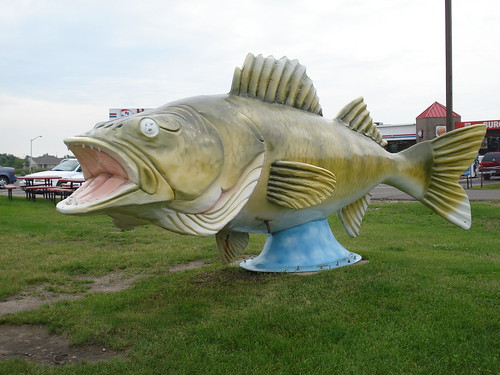
"World's Largest Walleye"

The sign next to this giant fiberglass fish makes the claim that it is the world's largest walleye. It's not. Not even close. Rush City also makes the claim as the Walleye Capital of the World. According to Roadside America, there are several other cities that make this very claim.

This fish was allegedly caught in Rush Lake by Paul Bunyan. The fish allegedly weighed 1999 pounds and 15.5 ounces, just shy of a ton. Paul allegedly used a 62 foot white pine for a rod, a 3 ton logger's winch for a reel, and a 1 inch manila rope for his line. If you're wondering what kind of bait to use to catch a giant fiberglass walleye, Paul used a 35 pound tiger muskie... allegedly.

Saturday, August 13, 2011

Bonus: World's Largest Totem Pole, Woodsy Owl, a fisherman, and a real castle

July 31 to August 4, 2010 - Northern California

World's Largest Totem Pole

This is the last old one before I get into the new ones from our recent trip. Last summer we went to visit my wife's sister and her husband who live in Eureka, CA. They were nice enough to take us to see the local big stuff.

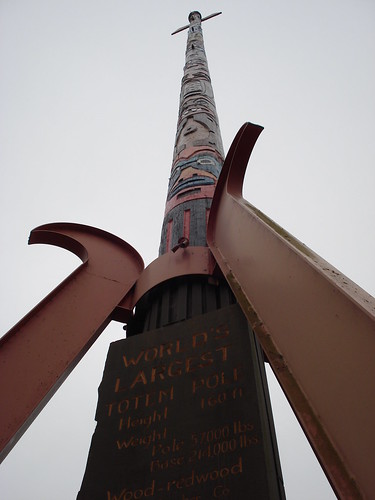
The World's Largest Totem Pole resides in nearby McKinleyville. There are a number of places along the Pacific coast that claim the world's largest totem pole, often with some kind of qualifier like "from one log" or something. At 160 feet, this one is definitely a contender. It was carved from one continuous log and weighs 57,000 pounds. The base that holds it up weighs 214,000 pounds.

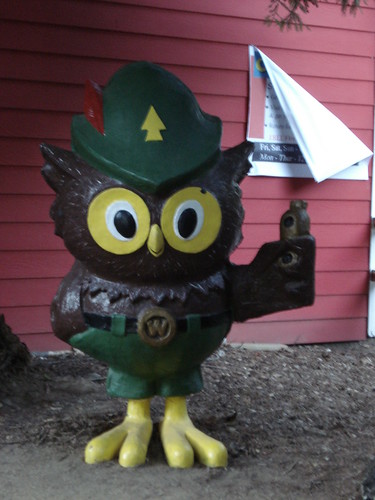
Our trip started by flying into Sacramento, where they drove down from Eureka to meet us. We spent that evening at the California State Fair, mostly because they had a beer fest that night. While exploring the fair grounds we came across a fiberglass Woodsy Owl.

Woodsy Owl

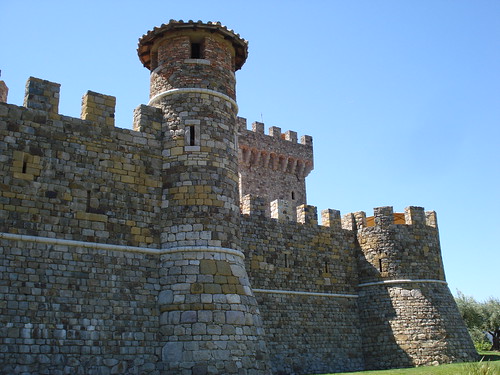
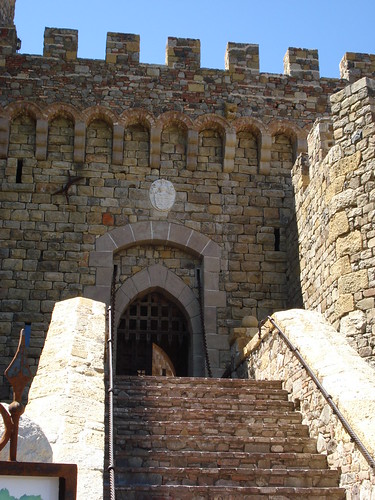
The next day we spent in the Napa Valley. One of our stops was a winery called Castello di Amorosa. It's a real castle. It was built using parts of old European castles and anything they couldn't find was built by hand to be as authentic as possible. It was pretty neat and well worth the tour admission. The wine was also very good. We ended up buying a few bottles.

DSC03246

DSC03250

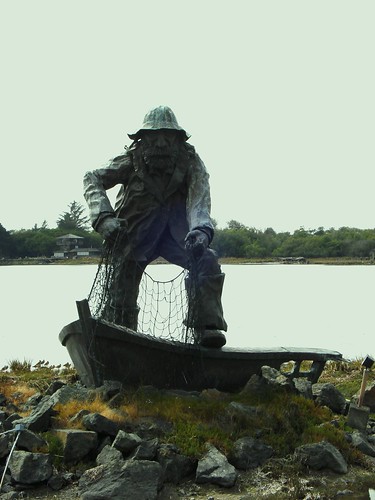
Finally, while in Eureka we went to the harbor and saw a large fisherman statue. It's surrounded by water, so you can't go right up to it. It's a memorial statue and it honors those "whom the sea sustained...and those it claimed." It was dedicated in 1981.

Large Fisherman

Sunday, July 17, 2011

Lou T. Fisk - World's Largest Codfish

September 22nd, 2009 - Madison, MN

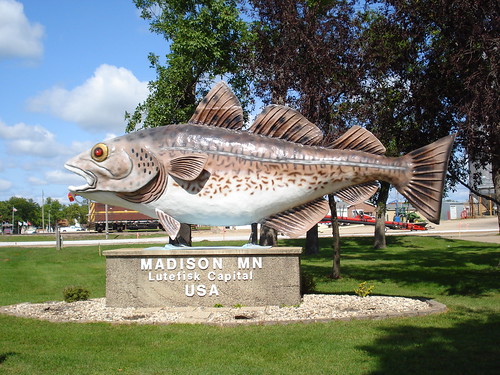
Lou T. Fisk

In 1982 two Madison Chamber members suggested to the city council that Madison should be nicknamed the Lutefisk Capital of the United States. So, naturally, they ordered a 25-foot-long fiberglass codfish from F.A.S.T Corp. in Sparta, WI. The project costs $8,000 (a bargain) and was funded by the Madison Chamber of Commerce.

Lou was officially dedicated in a ceremony on June 23rd, 1983 where he was paraded through town and placed in Jacobson Park at the south end of town. Lou was designed to be placed on a travel trailer so he could continue to participate in parades. He has even traveled the country including stops in Madison, WI, Madison, OH, Madison, NJ, Madison, NY, and Madison, CT.

On July 31st, 2008 a powerful storm packing winds of over 100 mph knocked Lou off of his base damaging the fish. He was sent back to F.A.S.T. and repaired. The repairs took about 6 months.

Each November, as part of Norsefest, the town holds a lutefisk eating contest, so if you've been itching to stuff your face with some delicious lutefisk then you should travel to Madison in November.

City of Madison's Lou T. Fisk page

Saturday, July 9, 2011

Paul Bunyan's Anchor, or The World's Largest Coat Hanger

September 22, 2009 - Ortonville, MN
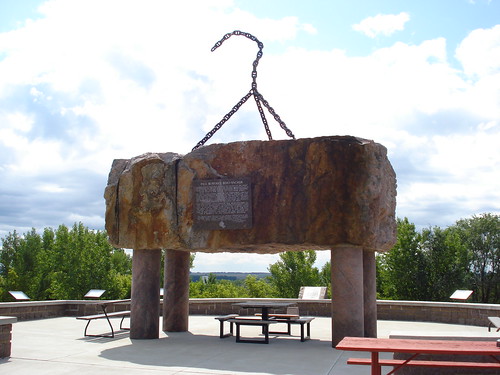
Paul Bunyan's Anchor

We were a little disappointed with this one. We were hoping for something a bit more anchory. While I'm sure it's effective, it looks more like a hanger made from a huge slab of granite and some giant chain links.

The legend goes that Paul Bunyan was quite the fisherman and that Big Stone Lake was one of his favorite lakes to fish in. According to the plaque, "Big Stone Lake, visible here to the north-west, and the state's 10th largest, was one of Paul's favorites, not only for the variety and size of its fish, but because here he found a stone heavy enough to anchor his mammoth boat. Squared roughly from the region's famous granite, it weighed 110 tons." It goes on to say that this anchor was (conveniently) rediscovered on the eve of Minnesota's statehood centennial in 1958 and then was hoisted to the hilltop it now resides on as a memento of the state's 100th birthday.

Now this is a lovely story, but it seems to me that it has one Bunyan sized hole in it. Big Stone Lake is a large lake covering 12,610 acres and stretching 26 miles long, but it is a really shallow lake. At it's max, Big Stone Lake is only 16 feet deep. I would think a boat big enough to carry Paul alone would displace enough water that he would be scraping the bottom, if not completely stuck, but then you add a 110 ton rock too. I don't think that boat is going to be able to navigate Big Stone Lake. I wonder what happened to his boat... and boat trailer.

On the plus side. The anchor is next to the county museum. We didn't go in the actual museum, but they had some kind of wild bird exhibit thing in a separate building that was actually very interesting. They had a large and varied collection of taxidermied birds and an informational CD about 10 minutes long to guide you through the collection.
Wednesday, July 6, 2011

Big Stuff is Back

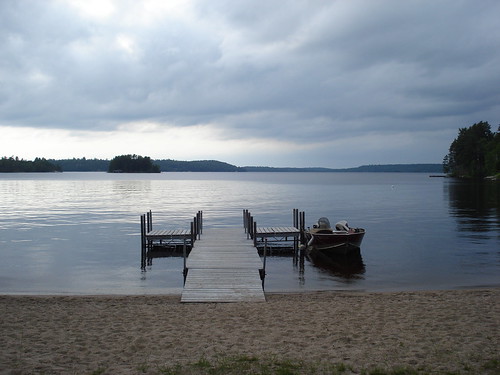
I mean it this time. We just got back from a vacation to beautiful Crane Lake in far northern Minnesota. We have a bunch of new blog material from this trip plus I have a couple of old ones that I never did post. So stay tuned.

Crane Lake

Monday, January 11, 2010

World's Largest Mallard

September 22, 2009 - Wheaton, MN

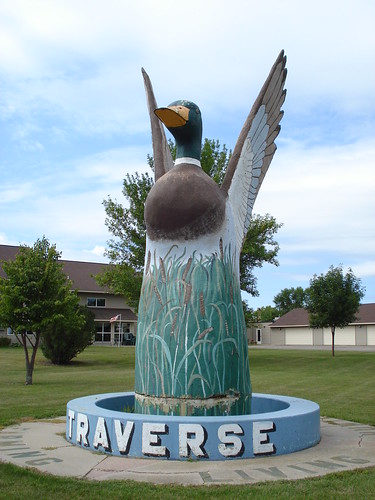
World's Largest Mallard

After we stopped in Starbuck for the giant hobo, we made our way to Wheaton to see the World's Largest Mallard. The statue stands 26 feet tall and depicts a mallard taking flight from a stand of cattails. It also has the county name, Traverse, around the base and some other words that I don't remember encircling the base; looks like "Living", "Farming", and something else. The statue was designed by Robert Bruns using "a paperweight, a Grain Belt Beer ad, and a dime store statue" as models. It was constructed out of concrete in 1959 by Elmer Oslon. The statue is showing it's age a bit.

The World's Largest Mallard has helped to cement (pun intended) this region of the state as the Land O' Ducks. Unlike much of the state, this part of Minnesota doesn't have a lot o' lakes but does have plenty o' ducks.

Friday, December 18, 2009

The Giant Hobo

September 22, 2009 - Starbuck, MN

Giant Hobo

Ok, it's time to get back to this blog thinger and finally get caught up. We got very busy buying a house and moving into that house and settling into that house and because of that and other fun grown-up stuff like figuring out insurance policies and retirement accounts, I haven't had much time to post. Like I mentioned in the last post, we now live in Plymouth, MN.

Way back in September we went on a western Minnesota big stuff loop. The first stop on this loop was in Starbuck. We didn't waste our time stopping for the buck with a star in it's antlers (I'm not kidding) or the site marking where the world's largest lefse was made. The lefse isn't there, because they ate it back in 1983, but the rolling pin they used is.

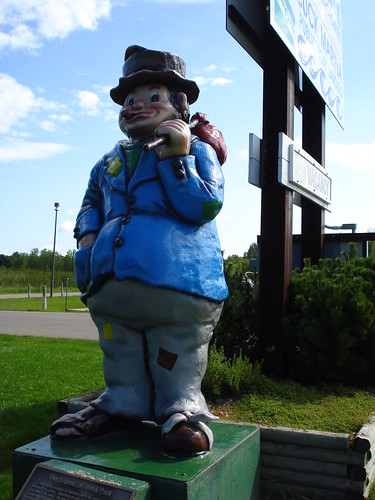
The giant hobo stands in Hobo Park. In the 1930s during the Great Depression many men would ride the freight trains and stop in Starbuck for a few days or weeks looking for work or food from the locals. At night they would gather near this spot along Lake Minnewaska. Before long they would hop on another freight train and move on, like any respectable hobo would. They left behind shorthand signs informing other hobos where they could find work or food or other helpful information.